
Ashok Kumar
EV Technology Specialist | 6 min read
India Electric Vehicle Market 2026: Current Sales Trends and Leading Companies
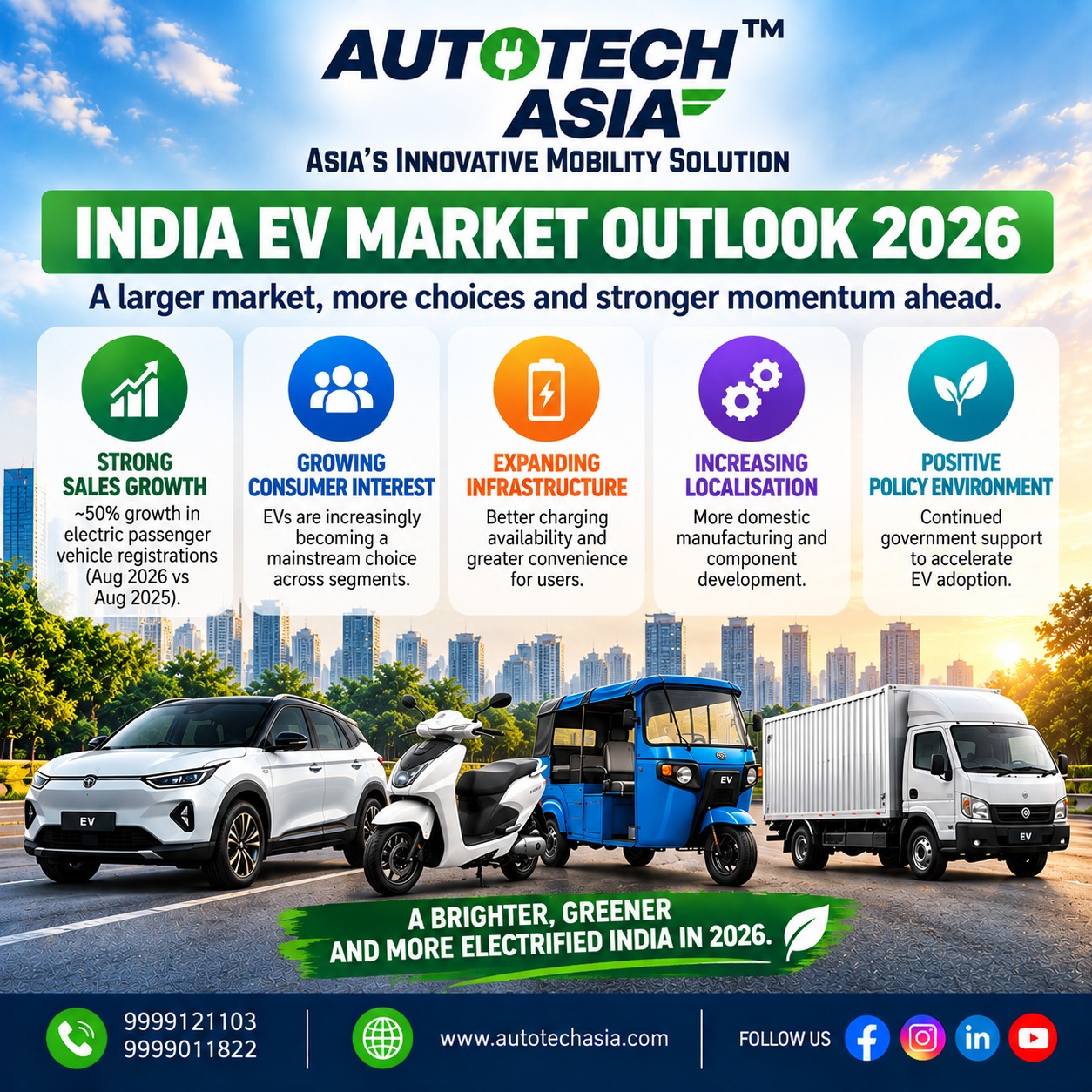
India’s electric vehicle market continues to expand in 2026, with electric cars, two-wheelers, three-wheelers and commercial vehicles becoming an increasingly important part of the automotive industry. The latest sales data shows that consumer interest in EVs remains strong, while competition between manufacturers is becoming more intense.
This growth is also increasing interest in the Electric Vehicle Exhibition in Delhi, where manufacturers, component suppliers, technology companies and industry professionals can explore the latest developments in electric mobility.
September 2026 EV Market Shows Continued Growth
September is still underway, so the available figures should be treated as month-to-date registrations rather than final monthly sales.
Vahan-based tracking showed around 31,000 electric passenger vehicles registered by September 26, with Tata Motors accounting for about 42.5% of registrations, followed by Mahindra at approximately 24.2% and MG Motor at around 15.3%. Maruti Suzuki and Hyundai were also recording registrations during the month.
The figures show that India's passenger EV market remains concentrated among several major manufacturers, while newer companies are gradually increasing their presence. These developments are also creating opportunities for businesses looking to participate in an Electric Vehicle Exhibition and connect with manufacturers, dealers and technology providers.

Tata Motors Continues to Have a Large EV Presence
Tata Motors remained the largest electric passenger vehicle manufacturer in August. FADA-based retail data recorded 13,158 Tata electric passenger vehicles, giving the company a market share of approximately 43%.
Tata's electric portfolio includes models such as the Punch EV, Nexon EV and Tiago EV. Its range of models across different price categories gives customers more options when considering an electric car.
The company's performance also highlights a broader change in India's EV market. Customers now have access to more electric vehicle models, while manufacturers are competing across price, range, design, technology and features.
Mahindra Expands Its Electric Vehicle Line-Up
Mahindra has also recorded strong growth in the electric passenger vehicle segment. In August, the company registered around 6,464 electric passenger vehicles, according to FADA data. This represented year-on-year growth of more than 50%.
Mahindra's electric SUV portfolio has helped strengthen its presence in the premium electric vehicle segment. Its XEV range has attracted attention from customers looking for larger electric SUVs, modern technology and longer driving ranges.
The company's September registrations were also running strongly, making Mahindra one of the manufacturers to watch as the month approaches its end.
MG Motor Maintains Strong Demand
JSW MG Motor India remains another important player in India's electric passenger vehicle market. The company recorded approximately 4,622 electric passenger vehicle registrations in August, according to FADA-based reporting.
The MG Windsor EV has been an important model for the company, particularly among customers looking for a practical electric vehicle with a spacious interior.
The company's presence also demonstrates how India's EV market is attracting international brands and joint ventures. This growing competition is encouraging manufacturers to invest in vehicle technology, battery systems, charging solutions and customer services.
VinFast Enters the Indian EV Competition
VinFast has attracted attention after entering India's electric passenger vehicle market. In August, the company recorded more than 2,000 electric passenger vehicle registrations and moved ahead of Maruti Suzuki in the monthly EV registration ranking.
New manufacturers can increase competition in areas such as vehicle design, battery technology, pricing, driving range and after-sales support.
As more manufacturers enter the Indian market, an Electric Vehicle Exhibition in Delhi can provide an important platform for companies to present new technologies and build industry connections.
Maruti Suzuki Builds Its EV Presence
Maruti Suzuki has entered India's growing electric passenger vehicle market with the e Vitara. August registrations were around 1,400 units according to FADA-based data.
Maruti's entry is significant because of its established position in India's passenger vehicle industry. Its expansion into electric mobility gives customers another major manufacturer to consider when looking for an electric car.
The arrival of established and new manufacturers is also increasing demand for EV components, battery technology, charging equipment and other automotive solutions.
Electric Two-Wheeler Market Is Also Growing
India's EV growth is not limited to passenger cars. Electric two-wheelers remain one of the country's largest electric vehicle categories.
FADA reported 1,83,204 electric two-wheelers sold at retail in August 2026, an increase of about 67% year-on-year. TVS Motor recorded 48,938 units, followed by Bajaj Auto with 41,114 and Ather Energy with 28,757 units.
Electric scooters and motorcycles are particularly relevant for urban commuting, delivery services and short-distance transportation. Their growing adoption is contributing to demand for motors, controllers, batteries, chargers and other EV components.
Growing Opportunities for EV Businesses
The latest sales numbers point toward a broader EV ecosystem in India. Vehicle manufacturers are launching new models, while demand is creating opportunities for battery manufacturers, charging companies, motor manufacturers, controller suppliers, power electronics companies and EV component manufacturers.
Industry exhibitions can help these businesses showcase their products and meet potential buyers, distributors and technology partners. Companies looking to participate as an EV Expo Exhibitor in India can use such platforms to demonstrate products, generate business enquiries and understand changing market requirements.
An Electric Vehicle Exhibition can also bring together manufacturers, dealers, distributors, investors, component suppliers and technology providers under one platform.
1. Electric Passenger Vehicle Sales — September 2026
India Electric Passenger Vehicle Sales — September 2026
Vahan retail registrations through 26 September 2026; full-month figures are projected from 25 of 30 days.
| Company | Sep 2026 Actual* | Projected Sep 2026 | Market Share |
| Tata Motors | ~13,000 | ~15,600 | 42.50% |
| Mahindra | ~7,000 | ~8,400 | 24.20% |
| MG Motor | ~4,000 | ~4,800 | 15.30% |
| Maruti Suzuki | 997 | ~1,196 | 3.20% |
| Hyundai | 766 | ~920 | 2.40% |
| Kia | ~869 | ~1,043 | 3.30% |
| Industry | ~31,000 | ~37,200 | 100% |

2. Electric Two-Wheeler Sales — September 2026
India Electric Two-Wheeler Sales — September 2026
| Company | Sep 2026 Projected Sales | Market Share |
| TVS Motor | ~63,600 | 26.70% |
| Bajaj Auto | ~57,600 | 23.90% |
| Ather Energy | ~36,000 | 14.90% |
| Hero Vida | ~27,600 | 11.80% |
| Ola Electric | ~14,400 | 6.00% |
| Greaves Electric | ~10,800 | 4.50% |
| Industry | ~2.02 lakh | 100% |

AutoTech Asia 2026 and India's EV Industry
AutoTech Asia 2026 provides an industry platform for businesses working across electric vehicles, batteries, charging infrastructure, components and automotive technology.
For an EV Expo Exhibitor in India, participating in an industry exhibition can provide opportunities to showcase new products, meet industry professionals and develop business relationships.
As India's electric mobility ecosystem develops, exhibitions are becoming useful platforms for discovering new EV technologies, components and business opportunities.
Conclusion
India's electric vehicle market is entering a more competitive phase in 2026. Tata Motors continues to record high electric passenger vehicle volumes, while Mahindra, MG Motor, VinFast and Maruti Suzuki are strengthening competition.
At the same time, electric two-wheelers are expanding rapidly, creating opportunities throughout the wider EV supply chain. September's final registration figures will provide a clearer picture once the month closes, but current data already shows that electric mobility is becoming an increasingly important part of India's automotive market.
For manufacturers, component suppliers, charging businesses and technology companies, the growth of India's EV industry creates opportunities to connect with the market through an Electric Vehicle Exhibition in Delhi. Businesses planning to become an EV Expo Exhibitor in India can use industry exhibitions to showcase their products and connect with potential customers and partners.
The continuing growth of electric vehicles also makes an Electric Vehicle Exhibition a valuable place to follow new technologies, market developments and emerging opportunities in India's automotive sector.
Comments (8)


David Kim
2 days agoGreat article! I'm particularly interested in the battery swapping technology mentioned. Has anyone here had experience with Gogoro's system in Taiwan? I'm curious about the user experience compared to traditional charging.

About the Author
Ashok Kumar
EV Technology Specialist
Ashok Kumar specializes in electric vehicle technology and infrastructure development across Asia.
Related Articles

Subscribe to Our Newsletter
Get the latest automotive technology insights delivered directly to your inbox